- Category: Article, Knowledge hub
How to Choose the Right Payments Stack for Your Brokerage
For a brokerage, payments are not just “how clients deposit.” Your payments stack directly influences how fast funded accounts go live, how regulators view your controls, how much capital gets tied up in reserves, and how much trust traders place in you.
Treating payments as a strategic part of your brokerage infrastructure is what separates scalable brokers from those constantly firefighting PSP issues. This article gives you a practical decision framework for choosing the right payments stack, clarifies the difference between PSPs and payment hubs, and shows where a unified solution like WxTrade fits in.
What a Payments Stack Really Is for a Brokerage
In brokerage, the payments stack is everything that moves money and keeps records aligned:
- The cashier and funding screens in your Client Portal (Trader Experience)
- The technical pipes that send card and bank data to processors
- The PSPs and acquirers who provide merchant accounts and settle funds
- The APMs (Alternative Payment Methods) your clients expect in each region
- Your internal CRM, ledger and trading platform, which must always know the truth about balances
The lifecycle is not a simple purchase. A client deposits, you credit their trading account, and then most financial activity happens internally. Later, the client requests withdrawals, sometimes followed by refunds or chargebacks. That cyclical pattern, especially in high-volatility markets, is one reason card schemes and processors classify brokers as high-risk merchants.
Because of that classification, PSPs scrutinize your business model, KYC and AML policies, and risk profile much more than they would a typical online store. The structure of your payments stack either makes that relationship manageable—or very painful
PSPs, Gateways, Payment Hubs and Your Backend
It helps to separate four distinct layers.
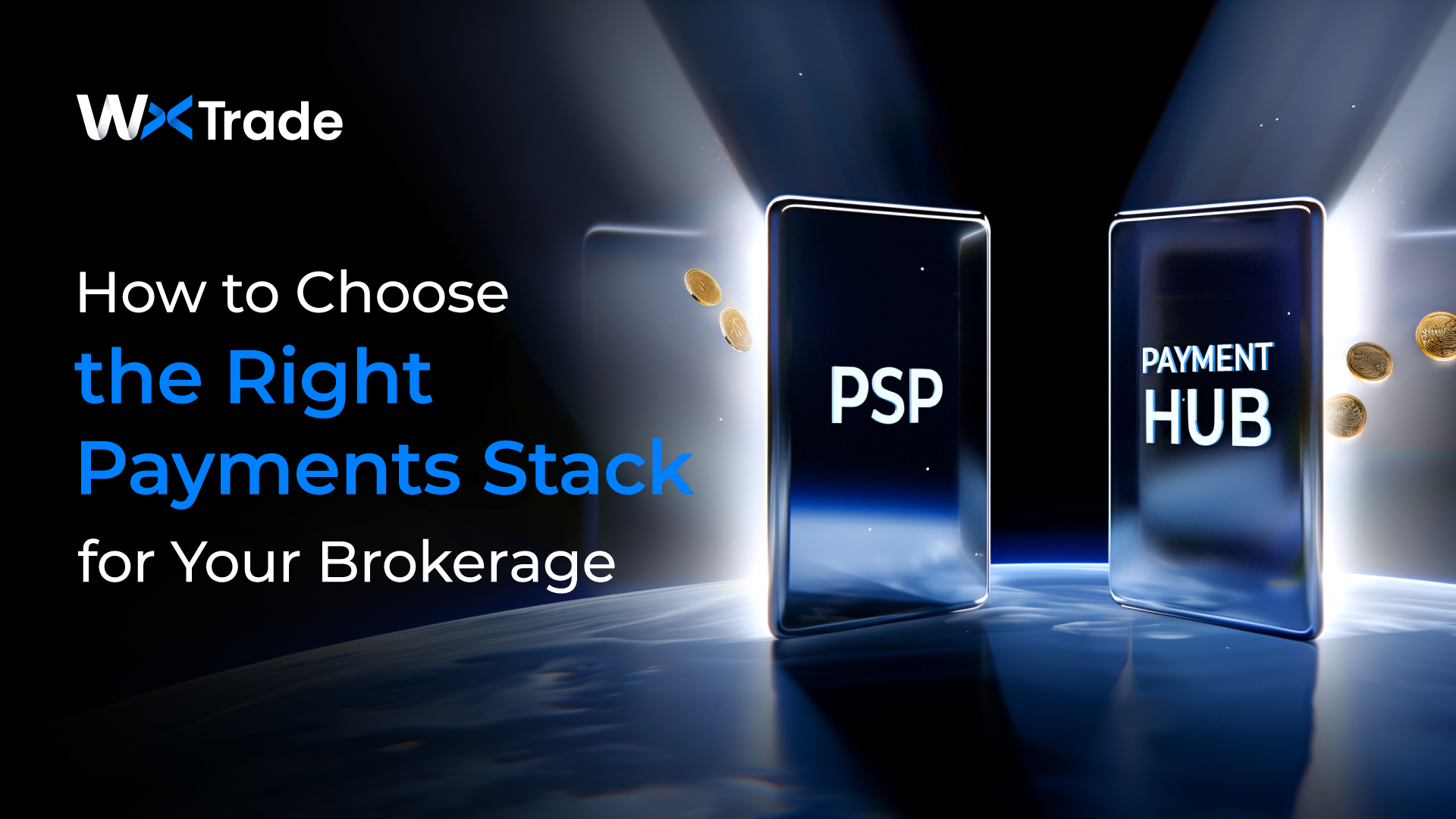
A payment gateway is mainly a secure technical conduit. It encrypts and passes card or bank details from your cashier to a processor. A PSP or acquirer is the financial institution that actually connects you to card schemes or bank rails, underwrites your risk as a merchant, authorizes transactions, manages settlements and handles chargebacks. Fees, rolling reserves, settlement cycles and even the right to keep processing all sit with the PSP.
A payment hub or orchestration platform sits above multiple PSPs and APMs. Instead of integrating each provider separately, you integrate once with the hub. It then handles smart routing (by country, card BIN, method), failover between PSPs, token vaults, and often centralized reporting.
Finally, your internal systems—CRM, the trading platform, internal ledger and reporting—need to stay synchronized with that external layer. They receive webhooks, update balances, enforce compliance rules, and reconcile PSP settlement data back to client money accounts.
When these layers are blurred, brokerages tend to over-commit to a single PSP “because they have an API” and delay thinking about routing, redundancy and reconciliation until problems emerge.
The High-Risk Reality of PSPs for Brokerages
From the PSP’s perspective, brokerage is structurally risky. Transaction patterns are volatile, chargebacks spike when markets move against clients, and flows are often cross-border and multi-currency. Fraudsters also like high-value, remote transactions. Card schemes monitor chargeback ratios closely; crossing common thresholds around 1% over time can trigger fines or even program exclusion.
To manage this risk, PSPs typically respond with higher fees and tighter terms:
- MDRs (merchant discount rates) that are noticeably higher than standard e-commerce
- Rolling reserves, where a percentage of each transaction is held for months
- Longer settlement cycles, especially in the first months of the relationship
- Conservative risk policies that can lead to sudden volume caps or even off-boarding
For a brokerage doing $10M a month in card deposits, half a percentage point on fees translates to around $600,000 a year. A 10% rolling reserve held for six months can lock up millions in working capital.
The basic conclusion: PSP selection is not just a pricing exercise; it’s a liquidity and risk-management decision.
Single PSP, Multi-PSP Patchwork, or Payment Hub?
Most brokerages fall into one of three architectures.
- Single PSP. This is the simplest model. One contract, one integration, one back office to learn. It works at very small scale but leaves you entirely exposed to that PSP’s risk appetite, coverage, and uptime. If they don’t support a new region or method you need—or if they decide to de-risk your vertical—your business feels it immediately.
- DIY multi-PSP. As the need for new geographies and methods grows, many teams bolt on additional PSPs directly. Coverage improves, but every new provider brings its own API, reconciliation format and operational quirks. Over time, the codebase and back office start to resemble spaghetti. Engineering spends more time maintaining payment integrations than building brokerage features.
- Payment hub / orchestration. In this model, you integrate once with a hub. That hub provides a catalogue of PSPs and APMs, handles routing and failover, and often normalizes reporting. There is an extra platform fee and some architectural planning required, but adding a new method or PSP becomes a configuration job instead of a new integration project.
Many scaling brokerages end up with a hub plus a curated set of PSPs underneath it, which balances coverage, control and complexity.
The Five-Pillar Decision Framework
To choose between these options—and between individual PSPs—use five pillars as your decision lens: Coverage, Cost, Risk, Reconciliation and Redundancy.
Coverage: Can Your Clients Actually Pay and Withdraw?
Start from your growth plan, not from a generic “supported countries” list. Which markets matter most in the next 12–24 months? What are the preferred funding methods in each? In some regions, local bank transfers or wallets outperform cards; in others, cards are still dominant but local acquiring is critical for approval rates.
Coverage also means withdrawals, not just deposits. Clients expect to cash out via the same channel they used to fund, and regulators often require closed-loop behavior. If a PSP or hub cannot support payouts or has restrictive rules in a key market, that’s a gap you will feel in support tickets and complaints.
Cost: Total Economics, Not Just MDR
The headline MDR is only part of the cost. You also need to consider per-transaction fees, cross-border surcharges, FX markups embedded in conversion rates, chargeback fees and, importantly, the economic impact of rolling reserves.
Pricing models matter too. Blended pricing is straightforward but hides the underlying scheme and interchange components; you may overpay on domestic debit volume. Interchange++ gives you transparency and the ability to benefit as your transaction mix improves, but introduces more variability.
Operational overhead is another cost. If each PSP requires custom integration work and manual reconciliation, your effective cost per funded account rises even if fees look good on paper. A hub plus a unified backend like WxTrade can reduce this overhead by standardizing data flows and automation.
Risk: Reserves, Holds and Compliance Exposure
The question here is not “Is this PSP risky?” but “How does this PSP manage risk, and what does that do to my business?”
You should understand the PSP’s policies on rolling reserves, settlement delays, and the conditions under which they might impose sudden holds or limits. You also need clarity on how they calculate and manage chargebacks, what monitoring thresholds apply to your MCC (such as 6211), and how they expect you to handle disputes.
On the compliance side, you want to see that your own KYC/AML rules, source-of-funds checks and transaction monitoring can be executed consistently through your payments layer and reflected in Wconnex. If your internal policy says “closed loop withdrawals only,” your payments providers must support that.
Reconciliation: Making the Numbers Match
Brokerage is unforgiving when it comes to reconciliation. Regulators, auditors and clients all expect that internal balances match external cash realities, across multiple currencies and segregated accounts. When PSPs provide limited or inconsistent data, the reconciliation process becomes manual and error-prone.
When you evaluate PSPs and hubs, look closely at the structure and timeliness of their settlement files, the stability of their transaction IDs, and the quality of their webhooks. The goal is to enable automated matching of at least the majority of transactions, with clear handling of edge cases.
Redundancy: Assuming Something Will Fail
Even well-run PSPs experience outages and incidents. Studies show that most sizable merchants experience at least one significant PSP outage per year, often during peak traffic.
For a brokerage, an outage during a major market move is particularly damaging. New clients cannot fund, existing traders cannot top up margins, and social channels quickly fill with complaints. Redundancy means planning for these scenarios: multiple PSPs in key regions, clear manual fallback procedures initially, and eventually automated routing through a hub.
The principle is simple: design your stack so that no single provider can stop your clients from funding or withdrawing
Conclusion and Next Steps
Choosing the right payments stack for your brokerage is ultimately about control. Control over where and how clients can fund and withdraw, control over your costs and reserves, control over your ability to pass audits and satisfy regulators, and control over your resilience when individual providers change course.
Clarifying the difference between PSPs and payment hubs is step one. Applying the Coverage, Cost, Risk, Reconciliation and Redundancy framework to your current and future setup is step two. Step three is architectural: aligning that payments design with a unified backend such as WxTrade—combining Wconnex CRM, client portal, core infrastructure and Open Integration Marketplace —so that payments integrations are just one more set of services plugged into a stable command center rather than a tangle that defines your destiny.